
Soccer is a game of constant movement, decisions, and adjustments. Players constantly transition between attacking and defending, often within seconds. While formations, individual skills, and tactical systems matter, one of the most fundamental aspects of defending is knowing where you are on the field and how that should shape your decisions.
One challenge I regularly see, especially with developing players, is that they defend the same way regardless of their position on the field. They chase the ball, commit to tackles too early, or leave spaces open because they haven't learned when to apply pressure and when to hold their position.
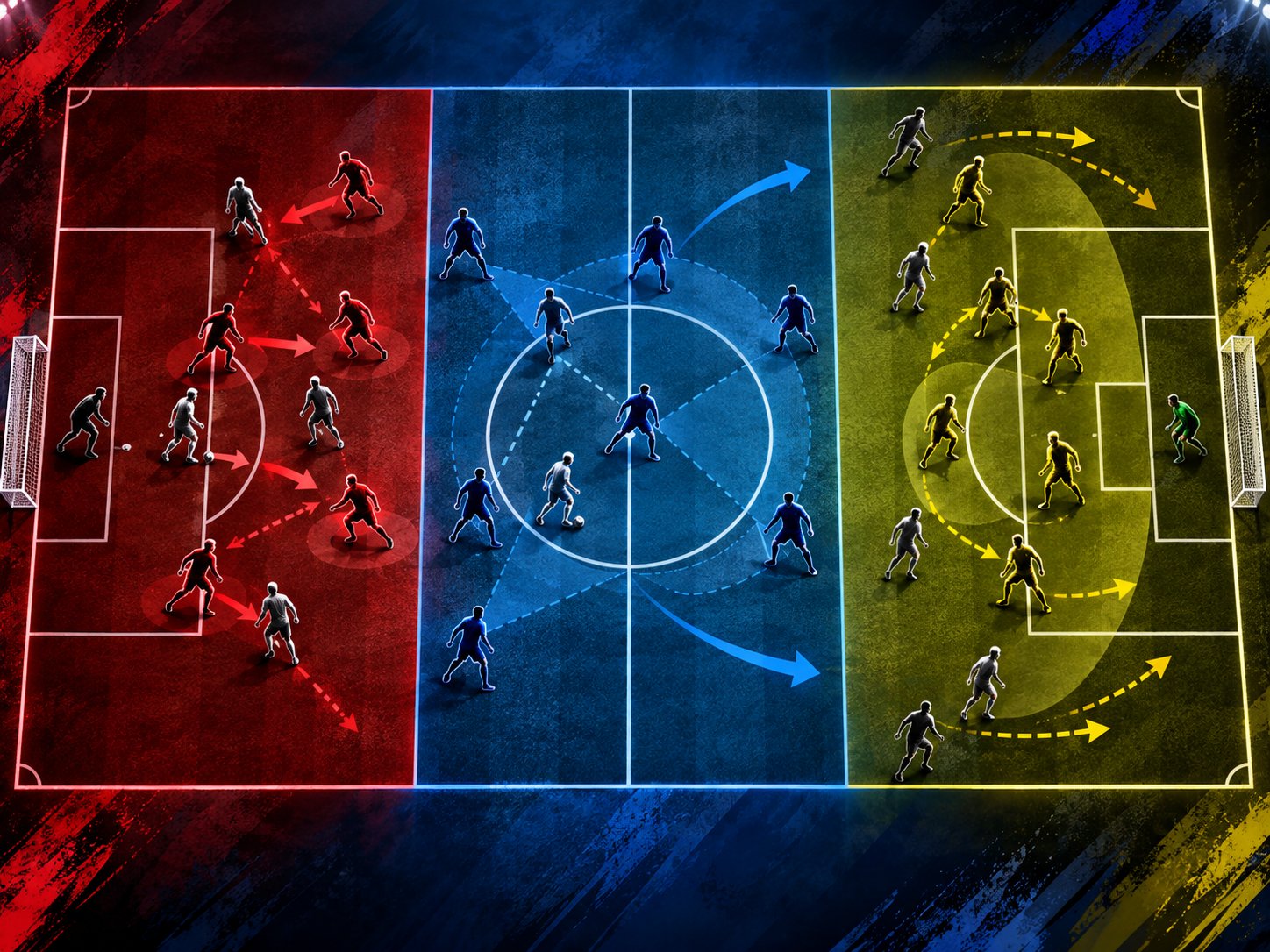
A useful way to simplify this is to divide the field into three areas, each with a different defensive priority:
- Final Third: Press. Apply pressure, force errors, and win possession quickly.
- Middle Third: Protect. Control space, prevent central penetration, and direct opponents into less dangerous areas.
- Defensive Third: Block. Stay compact, close passing lanes, prevent crosses, and protect the goal.
These principles are not a replacement for a team's tactical system. They provide a foundation players can understand and apply, whether they play a 4-3-3, 4-4-2, 3-5-2, or another formation.
The important thing is recognizing that good defending isn't always about winning the ball immediately. Sometimes the best defensive decision is to delay, contain, and protect the space around you.
The Final Third: Press and Force Mistakes
When the opposition has possession deep in their own half, particularly around their defensive third, our objective should be to make it difficult for them to build an attack. This is where pressing becomes important. Rather than giving defenders and goalkeepers time to look up, select a pass, and move the ball forward comfortably, we want to apply pressure that forces rushed decisions.
However, pressing doesn't simply mean running at the player with the ball. Effective pressing requires coordination, communication, and an understanding of where we want the opposition to play.
For example, when an opposing center back receives the ball, our forward might close them down from an angle that prevents an easy pass into central midfield. At the same time, supporting players should position themselves to restrict nearby passing options. The intention is to make the opponent's next decision increasingly difficult. There are several important principles players should understand in this area:
- Apply immediate pressure. Close down the player in possession quickly enough to limit their time and options.
- Force mistakes. Encourage rushed passes, poor first touches, or decisions that allow us to regain possession.
- Press together. One player applying pressure without support can easily be bypassed, leaving large spaces behind.
- Recognize pressing opportunities. A poor first touch, backward pass, or player receiving the ball facing their own goal can create an opportunity to press aggressively.
- Win possession quickly when possible. Recovering the ball close to the opposition's goal creates an immediate attacking opportunity.
One of the biggest mistakes teams make is confusing effort with effective pressing. Players can run constantly and still achieve very little if their movements aren't coordinated.
A forward sprinting toward the goalkeeper while the rest of the team remains deep doesn't necessarily create pressure. It often gives the opposition an easy opportunity to pass around that player.
Pressing is a team action, not an individual chase.
There is also an important balance. If the opposition successfully breaks the press, players must recognize that the situation has changed. Continuing to chase the ball individually can create even more problems. At that point, the priority becomes protecting the midfield.
The Middle Third: Protect the Center and Deflect Wide
The middle third is where many games are won or lost tactically. This is where teams attempt to establish possession, connect their defensive and attacking lines, and create opportunities to move into dangerous areas.
From a defensive perspective, our primary objective should be to protect central areas while making it difficult for the opposition to progress toward our goal. This is where patience and positional discipline matter most. Players often feel that defending means immediately attempting to tackle the opponent. However, a midfielder who rushes forward and misses a challenge can create a large opening for the opposition to exploit. Sometimes simply holding your position, slowing the attacker down, and removing their preferred passing option is far more effective.
Generally speaking, central areas offer attacking teams more options. From the center, a player may be able to pass left, pass right, play through the defensive line, or attempt a shot if they are close enough to goal. By directing play toward the touchline, we can reduce those options and make the opponent's next action more predictable. The key principles in this area include:
- Protect the center. Prevent easy passes and dribbles through central midfield, particularly into spaces between the defensive and midfield lines.
- Deflect play wide. Use positioning and body angles to encourage opponents toward the sidelines rather than allowing direct central penetration.
- Protect and engage. Wide players should remain aware of their defensive responsibilities and engage opponents when appropriate.
- Maintain team shape. Midfielders need to move together, keep reasonable distances between teammates, and avoid unnecessary gaps.
- Delay when necessary. If an immediate challenge is unlikely to succeed, slow the attack and allow teammates to recover their positions.
An important point is that deflecting wide does not mean letting the opposition attack freely down the wings.
We are attempting to move play into an area where we can better control the available space, support the defending player, and limit the opponent's options.
For example, if an opposing midfielder receives the ball centrally, our nearest midfielder might position themselves to block the forward passing lane while approaching from an angle that encourages a pass toward the wing.
Once the ball moves wide, our winger, fullback, and supporting midfielder can work together to contain the attack. That requires communication. It also requires players to understand that their job isn't finished simply because the ball has moved away from them. A midfielder who forces play wide and then stops tracking the movement may allow the opposition to recycle possession straight back into the center. The objective is not simply to move the ball wide. It is to protect the dangerous areas while maintaining control of the defensive situation.
The Defensive Third: Block, Stay Compact, and Protect the Goal
Once the opposition enters our defensive third, the priorities change again. We are now defending much closer to our own goal, where individual mistakes can have immediate consequences. This is where blocking, compactness, and preventing dangerous deliveries become critical.
Players need to recognize that the risks of an unsuccessful challenge are much greater in this part of the field.
A midfielder missing a tackle near the halfway line may still leave several teammates behind. A defender diving into a challenge inside the penalty area could leave an attacker with a clear opportunity to score. That doesn't mean defenders should avoid tackling. It means they must become more selective and disciplined about when and how they engage. The defensive third requires several key behaviors:
- Stay compact. Keep the defensive unit organized and avoid unnecessary gaps between defenders and midfielders.
- Close passing lanes. Make it difficult for opponents to find players in dangerous central positions or behind the defensive line.
- Prevent central penetration. Protect the space directly in front of goal and avoid allowing attackers to move freely through the middle.
- Stop dangerous crosses. Wide defenders should close down attackers and attempt to prevent quality deliveries into the penalty area.
- Block shots and passing opportunities. Position yourself to reduce shooting angles and protect the goalkeeper.
- Communicate constantly. Defenders and the goalkeeper must work together to identify runners, manage space, and organize the defensive line.
When an opponent reaches a wide position near our penalty area, the defender should recognize the danger of allowing an uncontested cross. However, stopping the cross should not mean diving in or letting the attacker cut inside into an even more dangerous position.
The defender must balance pressure with positioning, using the touchline and teammate support to limit the attacker's options. At the same time, defenders inside the penalty area must stay aware of opposing attackers, passing lanes, and potential second balls. Stopping one attacking option offers little benefit if we leave another completely unprotected. The principle of compactness also applies to the relationship between defenders and midfielders. If the defensive line drops toward the goal but the midfield remains too far forward, the opposition can exploit the space between those units. That space can be particularly dangerous because attacking midfielders may receive the ball facing goal, with time to shoot or play a final pass.
Good defensive organization means protecting space collectively, not simply having enough players near the goal.
Putting the Three-Thirds Together
Although we divide the field into three areas to explain these concepts, soccer doesn't operate in three separate sections. The game flows continuously, and players need to recognize when their defensive responsibilities should change. A team might begin by pressing high, lose the opportunity to recover possession, and then need to reorganize through midfield before defending deep around its penalty area. The challenge is making those transitions quickly and collectively. Consider a simple example.
Our forward presses the opposition's center back, attempting to force a mistake. The defender plays through the pressure into midfield. Our midfielders must now recognize that the initial press has been beaten and prioritize protecting the central areas. The opposition then moves the ball toward the wing and progresses into our defensive third. Our fullback engages the wide attacker, the midfield recovers to support, and the defensive line remains compact to prevent a dangerous cross or central pass. Throughout that sequence, the defensive objective changes based on where the ball is and what the opposition is trying to achieve. That is why I believe players need to understand these principles rather than simply memorize instructions for their individual positions.
A few questions every player should continually consider are:
- Where is the ball, and what is the immediate danger?
- Should I press, contain, or protect space?
- Where are my teammates, and am I maintaining our team shape?
- What passing options am I allowing or preventing?
- If the opposition beats me, what space am I leaving behind?
These decisions happen quickly, and players won't always get them right. But the more consistently teams practice these principles, the more naturally players recognize when to apply them.
Defending Is About Making the Right Decision
One of the biggest lessons players can learn is that effective defending is not measured simply by how many tackles you make or how often you win the ball. A player who closes a passing lane, delays an attacker, or forces the opposition into a less dangerous position may have made an excellent defensive contribution without ever touching the ball. That understanding is important at every level of soccer, from youth development through competitive adult teams. The three principles provide a straightforward foundation:
- Press in the final third: Apply coordinated pressure, force errors, and try to win the ball back near the opposition's goal.
- Protect in the middle third: Control space, defend central areas, maintain shape, and encourage play toward less dangerous positions.
- Block in the defensive third: Stay compact, prevent dangerous crosses and passes, close shooting opportunities, and protect the goal.
Of course, these are general principles rather than absolute rules. Some situations call for a team to press aggressively in its defensive third, while others call for it to sit deeper rather than press high. Those decisions depend on the opposition, the match situation, and the tactical approach established by the coaches. What matters is that players understand why they are being asked to defend in a particular way, rather than simply reacting to wherever the ball happens to be. Ultimately, the best defensive teams aren't necessarily the ones that run the most or tackle the hardest. They are the teams that communicate, stay organized, understand their responsibilities, and make good decisions together.
Press when the opportunity is there. Protect when the space matters. Block when the goal is under threat.
Above all, remember that defending is a team responsibility, no matter where you play on the field.